Solar System
Introduction
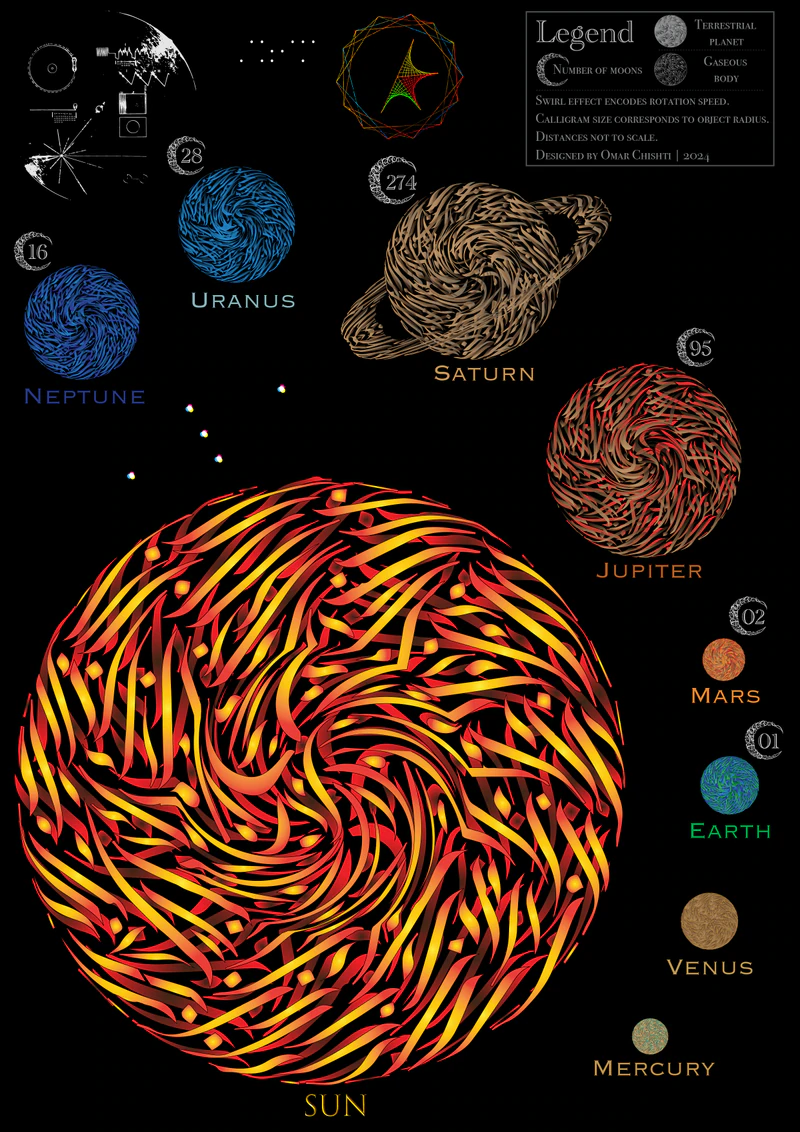
This piece depicts the sun and planets of our solar system using random-strokes calligrams in different colours & sizes. The simplest of the visualisations I have put together has proved the most popular. I have always wondered what exactly might be responsible for the outlying appeal, so I could perhaps try to recreate with the essence. There just is something about it that speaks to people. The first print I ever sold was this one (for $100, while a friend was visiting me in Berlin).
Origin & Creation
The original calligram that forms the basis of this visualisation was drawn on paper in New Haven back in 2022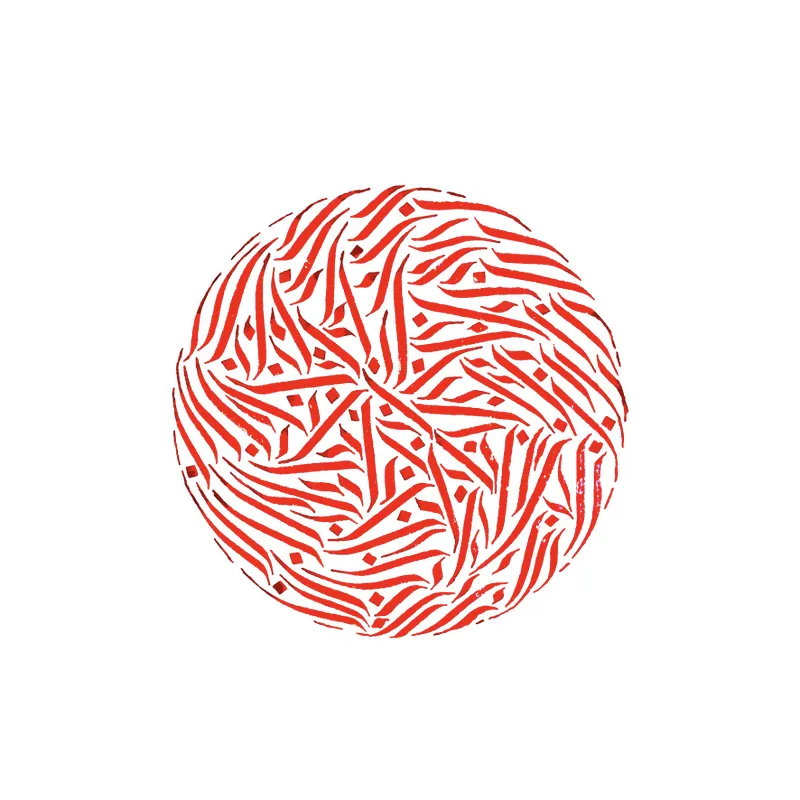 Figure a. The original calligram, red ink on Strathmore paper, New Haven, 2022., when I had just graduated from Yale and decided to go back to practising the childhood hobbies that had helped me get there. I digitised it for colouring and manipulation.
Now that I have turned it into a motif that recurs across my visualisations, I find myself grateful for the attention paid to every serif. Artefacts were introduced and removed along the way — photographing and vectorising hand-drawn elements comes with a lot of opportunities to set parameters for thresholding, smoothing, and so on.
The calligram is obviously inspired by the sun it evolves to represent, but the resemblance to how the sun is depicted on the Japanese flag isn't a coincidence. A college friend from Tokyo had given me a beautiful postcard playing with red, white, and the softest gold during the COVID years that inspired this depiction.
Design & Data
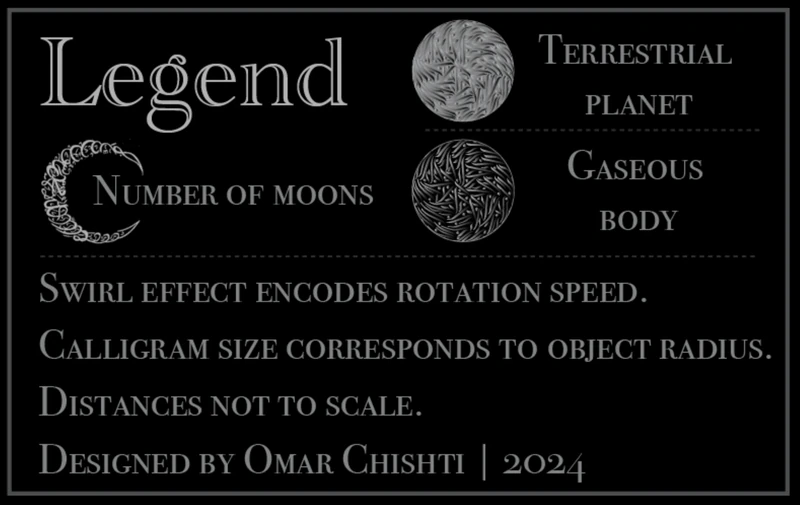
Radii, elemental state, number of moons, and rotation speed are encoded visually. The eight planets are arranged on an elliptical path in order of increasing distance from the sun from bottom-right to top-left. While I am partial to Pluto, I left it out. Data regarding the solar system were taken from IAU (International Astronomical Union) and NASA (National Aeronautics and Space Administration).1 It's important to note that the scaling only worked if I let the area of the calligram correspond to the radius of the body it depicted. If area varied proportional to area, everything would vanish in relation to the sun. I had to edit the number of Saturn's moons from 146 to 274 recently, to reflect astronomy's updated catalogue. I read that they have to dig around for obscure deities to find names for all these new moons to keep with convention. Io remains my favourite one.aIo is Jupiter's innermost Galilean moon, discovered in 1610. It's the most volcanically active body in our solar system. Its name comes from a priestess of Hera in Greek mythology who was seduced by Zeus.
The colours I use for the gradient fills were sampled from images of the planets. The Arabic calligraphy that forms the crescent used for the moon marker in this piece is a verse from the Quran. It's taken from the only memento I bought during my first visit to Istanbul to see a friend in the spring of 2019.
Inspirations
This piece was completed in June 2024. I used calligrams partially as a nod to one of my previous creative outlets (calligraphy, chiefly Gothic Fraktur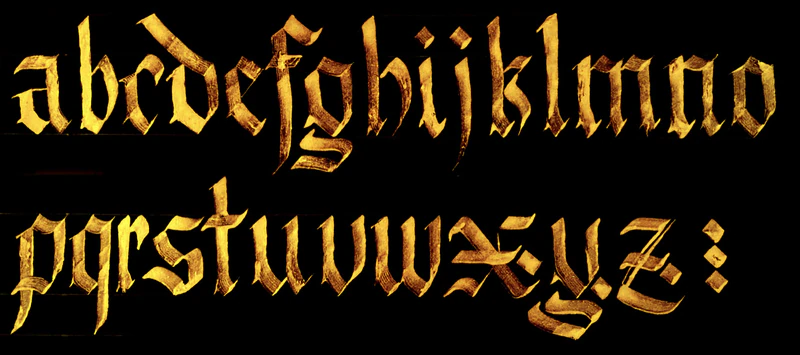 Figure b. The alphabet in Gothic Fraktur, gold ink on black paper (2022). Fraktur emerged in the early 16th century and remained the dominant typeface in Germany until the 1940s.), and partially to try to explicate a link between the strokes of our thoughts and the dance of our celestial neighbours. There is a reason the piece on the solar system follows the previous piece on music — the music of the spheres, musica universalisbAn old metaphor linking mathematics, music, and the cosmos through the imagined harmony of celestial motion.. Astronomy is to sight what music is to sound, in the fashion of the ancients.2 As the [spurious, but still poignant] quote popularly attributed to Pythagoras goes, "There is geometry in the humming of the strings, there is music in the spacing of the spheres."
I find that the calligram especially shines in capturing the plasma state of the sun. The degree of swirl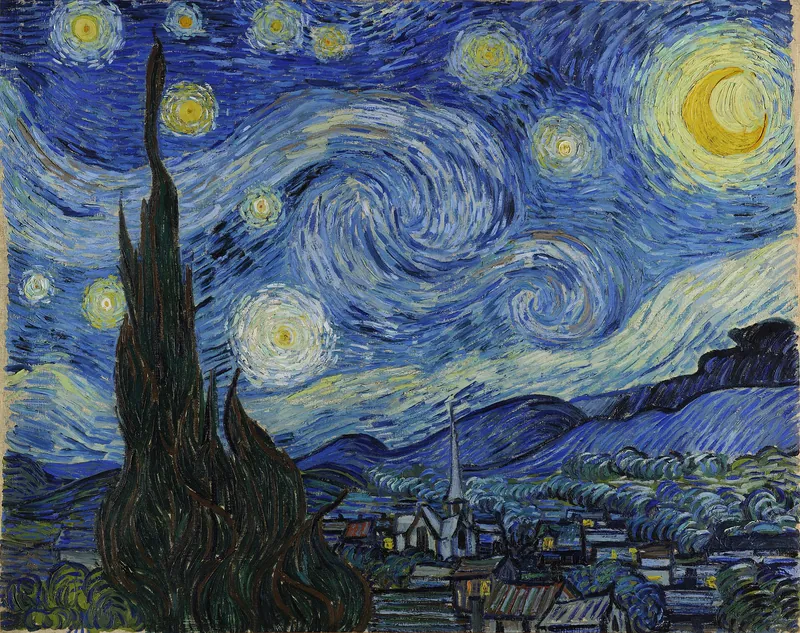 Figure c. Van Gogh, The Starry Night, 1889. The sky is built from repeated whorls and eddies, making motion legible even in a still image. effect encoding (logarithmically) the rotation speed is meant to add a somewhat hypnotic effect and suggest hints of movement in a still medium.
Part of what I am after there is the older visual force of the whorl itself: the curve as a carrier of energy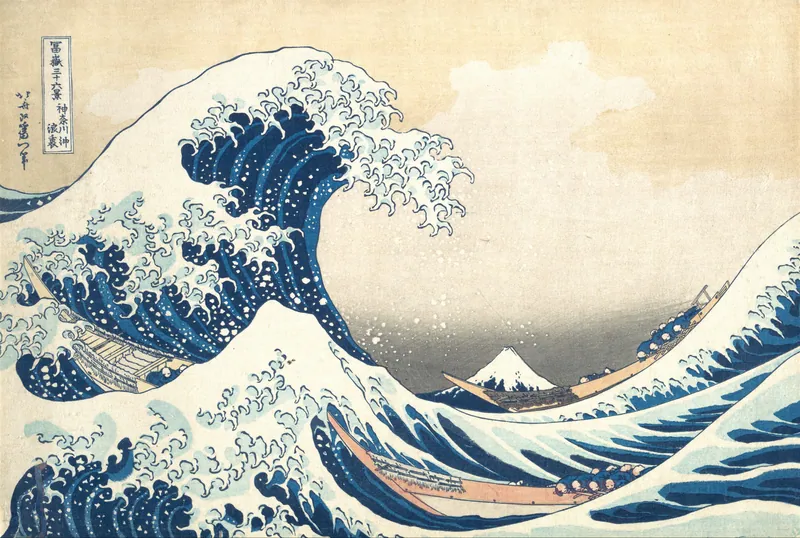 Figure d. Hokusai, The Great Wave off Kanagawa, c. 1831. The curve is not decorative but structural: the whole print is organised around the force of the breaking wave. rather than a mere decorative flourish, the visible onset of turbulent flow.
The black negative space I use throughout the series is especially well suited for the vast emptiness of space. I have made alternative versions of this piece that include a backdrop of stars and vanishing lines connecting them in a loose Voronoi tessellation.cA Voronoi tessellation divides space into regions based on distance to points in a specific subset. Each region consists of all points closer to one particular seed point than to any other. The resulting pattern appears throughout nature.
Personal Touches
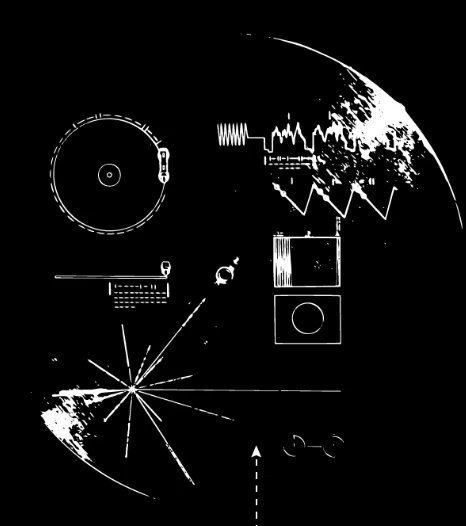
A sketch of the Voyager Golden RecorddThe Voyager Golden Record contains sounds and images selected to portray the diversity of life and culture on Earth. It includes music from different cultures, greetings in 55 languages, and natural sounds. from 1977 is included in the top left margin, reflecting its position in interstellar space well beyond the margins of our domain. It's a hauntingly beautiful summation of humanity, this grand effort to fling up a probe to pierce through the mantle of our cosmic lonelinesseOnce you take flight to live in the world of ideas you can find plenty of great company up above, but must eventually face that we are doomed to soar within our own abstract walled-off dimensions of intangibility never to truly touch. I tried devoting life to studying connection itself, from the wiring of the cortex to diverse fields of thought, but I suspect some quests for solace are best left to deciphering the patterns of the stars. At least momentarily we fly, à la poursuite d'un oiseau bleu..
I included my maternal grandfather's name (Azim) in Braille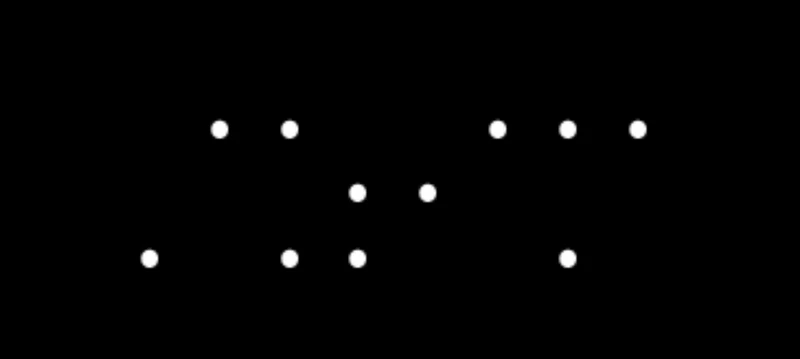 Figure e. Braille detail. My maternal grandfather's name, Azim, encoded tactually into the piece. at the top of this piece. As a child, I had promised to write his name in the stars. I imagine he would be amused by the form they take, so even the blind can see. It's one of the great sorrows of this life that although all my dreams came true, they waited till the one who inspired me to dream in the first place was no longer around to share in their fruition. Nana would have understood the eventual vision, with all its beautiful twists and scattered pieces, in a way perhaps no one ever can — because it first began to bloom in his own blood. Proxy fulfilment of an ancestral destiny.
Finally, a reference to my favourite constellation (composed of Orion's belt and two adjacent stars — Rigel & Betelgeuse — that complete a 'diamond') is included in the piece.
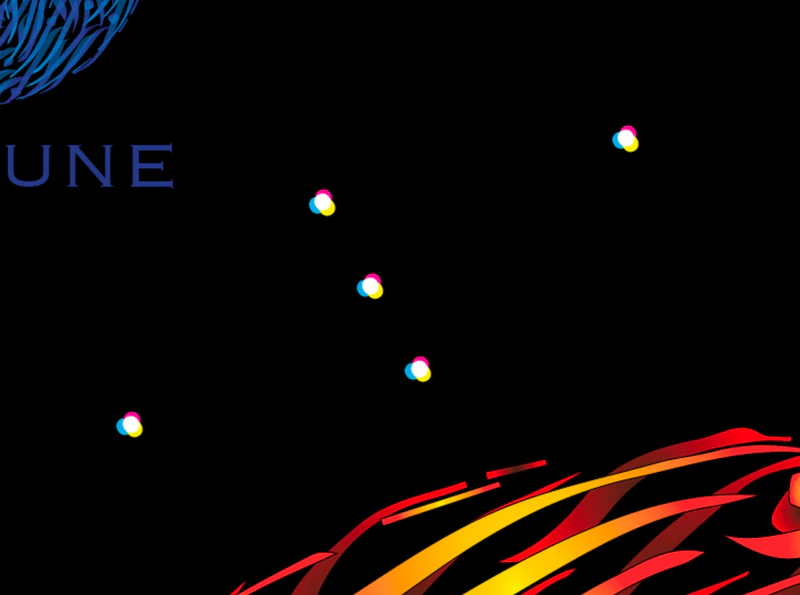
I'll save my relationship to this enigmatic set of five stars for a future piece of writing, but I hope the little tricks of perception I implemented with cyan, magenta, and yellow succeed in making them stand out.
All this to say merely that there is a surprising amount of sentiment, somewhat warm & somewhat sad, hidden behind this seemingly sterile piece. Maybe the weight of all that unrequited love and unfulfilled promise and unspoken sorrow is why it often strikes a chord.